

Wallace Michaels
Only in the Sipp
There is something fitting about a library becoming a park.
For decades, the building at the corner of North State Street and Amite Street was a place where Jacksonians went looking for stories. Children discovered books there. Students did research. Readers found favorite authors. Generations of families walked through its doors, carrying home pieces of other people’s imaginations.
Now, the building is gone.
But the idea of the place as a gathering spot is about to take on a new form.
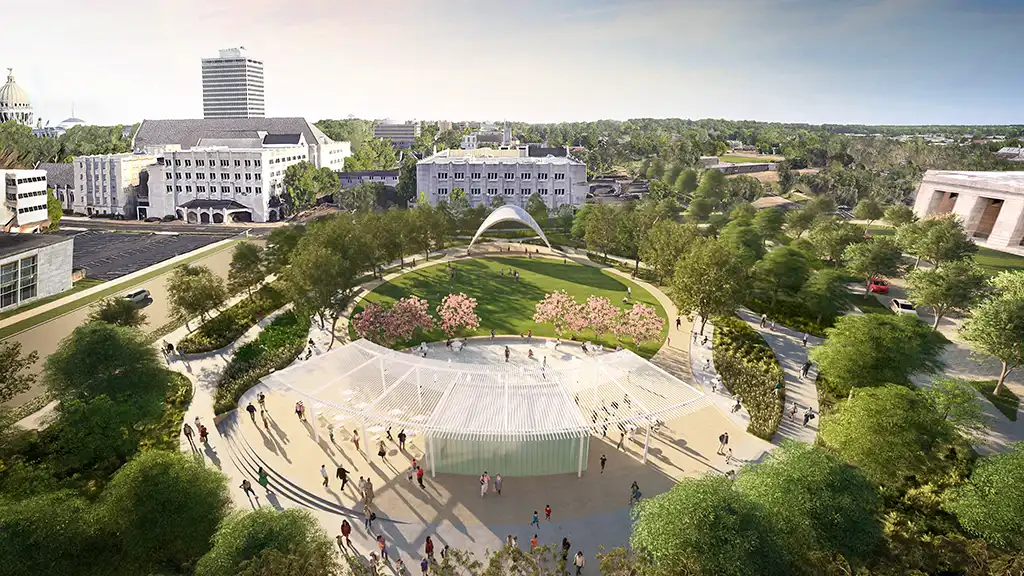
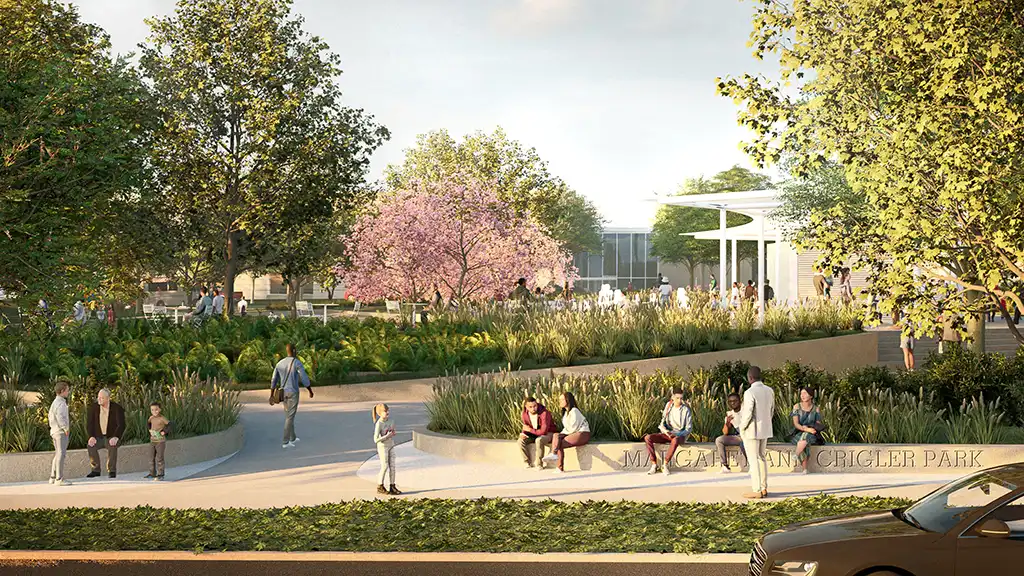
On the site of the former Eudora Welty Library, Margaret Ann Crigler Park is taking shape as a new kind of downtown destination—one built not around bookshelves and reading rooms, but around trees, open lawn, children’s play, music, art and the simple pleasure of being outside.
And in a city with a remarkably deep sense of place, the story of the park reaches much further back than the library that once occupied the property.
A green space with a Jackson story
When Jackson was laid out in 1822, its original city plan included a series of public green spaces woven into the developing capital.
Nearly two centuries later, only a handful of those original spaces remain.
Crigler Park offers an opportunity to bring that early vision back into downtown Jackson.
The roughly two-acre park will sit directly beside the Two Mississippi Museums, creating a new outdoor counterpart to the Mississippi Civil Rights Museum and the Museum of Mississippi History. Rather than simply giving visitors another place to walk, the park is being designed to encourage them to linger—to gather with friends, bring children to play, listen to music, attend an event or simply sit beneath the trees.
It is a modern park with an old-fashioned idea at its heart:
A city is better when people have places to gather.
From Sears to Welty to Crigler
The property itself has lived several lives.
The building that once stood there was constructed in 1946 as a Sears department store. Its Art Moderne/International-style architecture reflected a changing Jackson and a changing America.
Eventually, the building became the Jackson Municipal Library and later the Eudora Welty Library, carrying the name of one of Mississippi’s most celebrated writers.
For generations, it was a familiar downtown landmark.
But time was not kind to the aging structure. Years of deterioration brought serious problems, including roof leaks, broken water pipes, damaged masonry and flooring, and failing mechanical systems.
When the library eventually moved, the question became what should happen to the property next.
The answer was not simply to clear the site and move on.
It was to imagine what could come next.
That vision became Margaret Ann Crigler Park.
A memorial without walls
The park’s name honors Margaret Ann Crigler, a longtime Jackson philanthropist whose life was marked by family, friendship, business and a commitment to giving back.
Following her death in 2021, her husband, Noble T. Crigler, made a $1 million gift toward the creation of the park.
There is something especially appropriate about memorializing a person through a public space.
A statue is visited.
A plaque is read.
But a park is lived in.
Children will play there. Musicians will perform there. Families will meet there. Visitors will pass through. People who never knew Margaret Ann Crigler will nevertheless become part of a place bearing her name.
Her legacy, in other words, won’t simply be remembered.
It will be experienced.
Designed for Mississippi
The park’s design embraces something Jackson has in abundance: its landscape.
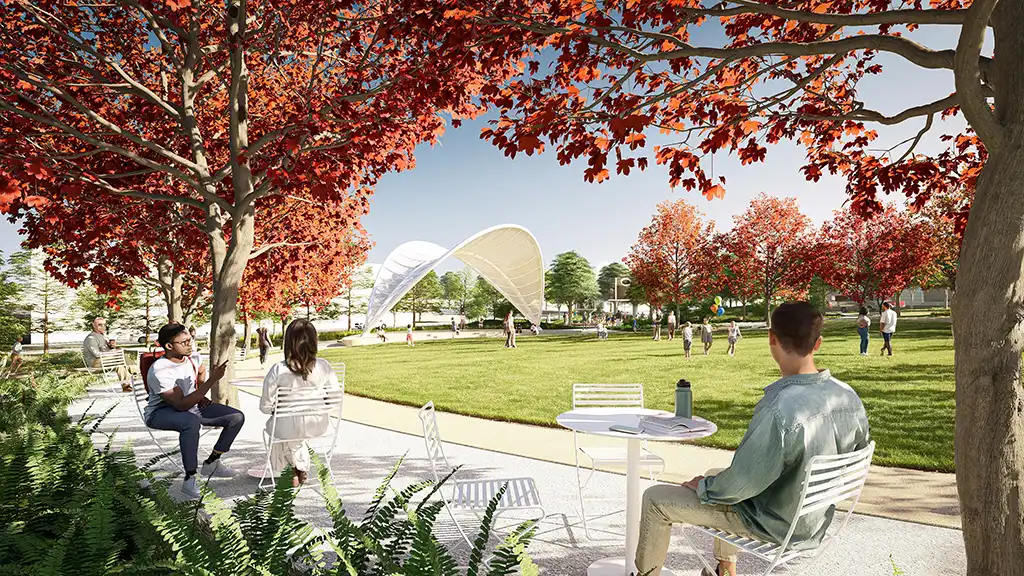
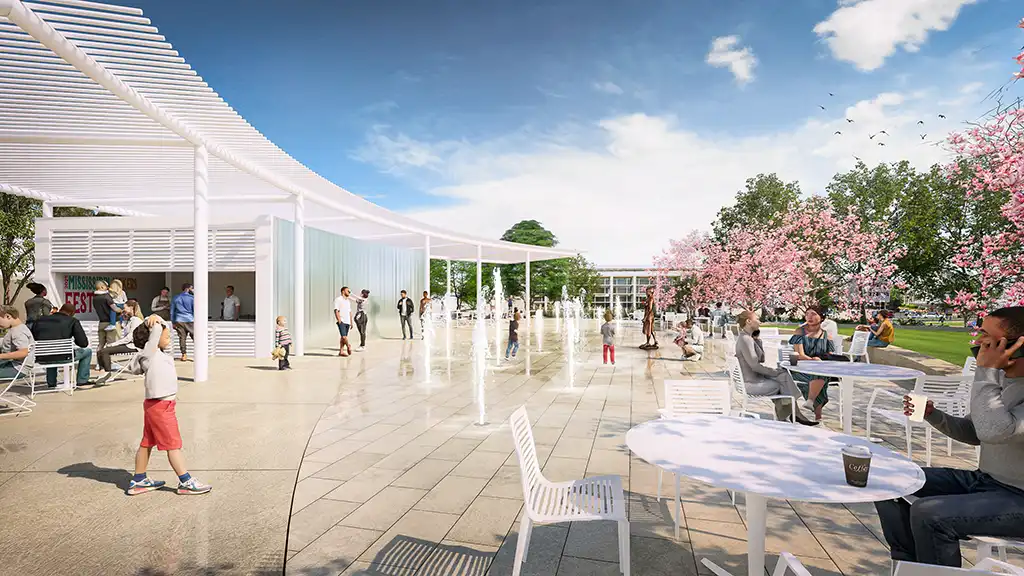
Native Mississippi plants will help shape the space, while an expansive community lawn will provide room for festivals, gatherings and everyday use.
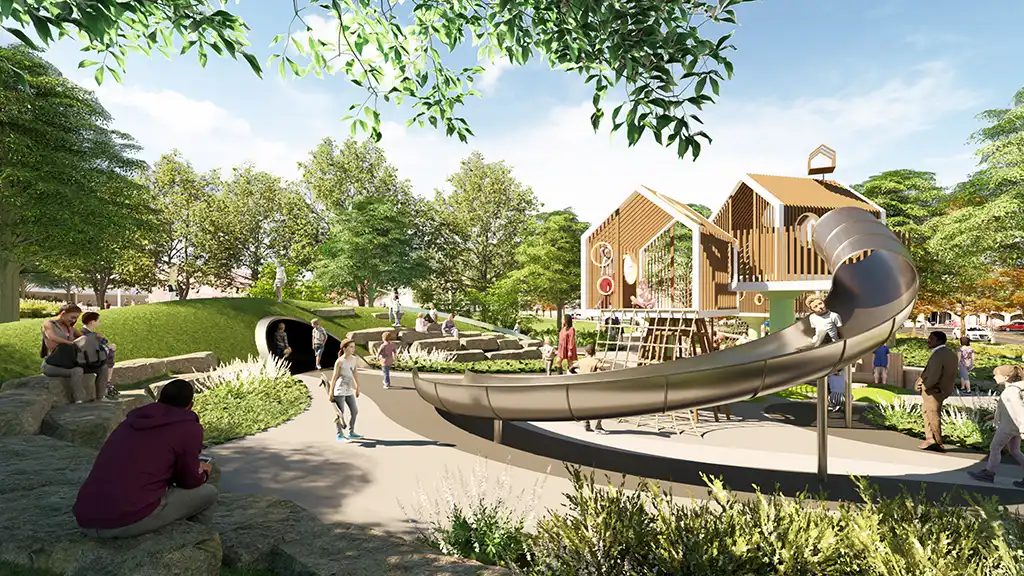
A natural, treehouse-inspired play area will give children a place to explore. An outdoor stage or bandshell will create a setting for music and performances.
And the park will connect to the Museum Trail, helping link downtown Jackson with the city’s growing collection of cultural destinations.
That connection may ultimately become one of the park’s most important contributions.
Visitors could move from the history inside the museums to the landscape outside, then continue along the trail toward other museums and destinations.
History becomes movement.
Culture becomes experience.
Downtown becomes a little more connected.
The stories don’t stop at the museum door
Museums are places where stories are carefully preserved.
Parks are places where stories happen.
Crigler Park has the potential to be both.
A child who visits the Museum of Mississippi History might leave with a new understanding of the state and then spend an afternoon climbing through the park’s natural play area.
Someone attending a performance on the outdoor stage might discover the museums next door.
A family visiting Jackson might stop for lunch, wander through the park and then walk into an exhibit.
A downtown worker might simply find a shady place to sit for a few minutes.
None of those moments requires an admission ticket.
That is part of the beauty of a public park.
A community investment
The park is also a story about what can happen when a community decides that a piece of its city is worth investing in.

The Mississippi Legislature has committed $3 million to the project. Additional support has come from the Community Foundation for Mississippi’s John and Lucy Shackelford Fund, the Junior League of Jackson, the Phil Hardin Foundation, the Mississippi Arts Commission and anonymous donors.
Each contribution represents something different—philanthropy, public investment, support for the arts, a commitment to children and education.
Together, they point toward the same belief: Jackson’s public spaces matter.
Looking toward the next chapter
It is easy to look at an empty construction site and see what is missing.
The old building is gone. The familiar landmark is no longer there. The shelves, books and quiet rooms that once defined the property have disappeared.
But an empty site can also be an invitation.
Imagine the first concert on the lawn.
A child discovering the play area.
A family spreading a blanket beneath the trees.
A visitor walking from the museums into the park and realizing that the history of Mississippi isn’t confined to four walls.
Imagine downtown Jackson on a warm evening, with music drifting across the grass and people gathering beneath the trees.
That is the promise of Crigler Park.
It is not trying to replace what was there.
It is carrying the idea of what that place has always been—a gathering place—into its next chapter.
The library once invited Jackson to come inside and discover a story.
The park will invite people to step outside and become part of one.
And perhaps that is the most Mississippi thing about it.
The stories continue.
They simply find new places to live.
The back story
The Mississippi Department of Archives and History (MDAH) announced $1.4 million in new funding to support the development of Margaret Ann Crigler Park in downtown Jackson, with $500,000 from the Phil Hardin Foundation, $500,000 from the Mississippi Arts Commission through its Building Fund for the Arts (BFA) program and two separate $200,000 gifts from anonymous donors.
Margaret Ann Crigler Park will be adjacent to the Two Mississippi Museums and will include a large open green space, an outdoor stage, and a natural play area for children. A new anchor on the city’s museum trail, a walking and biking trail that connects the museums at LeFleur’s Bluff to museums downtown, Crigler Park will feature Mississippi’s native foliage.
“This project not only links the Two Mississippi Museums to downtown but also expands our capacity for public programming that contributes to a vibrant arts and culture landscape in the community,” said Katie Blount, former Mississippi Department of Archives and History director.
Plans for Margaret Ann Crigler Park align with the original layout for Jackson from 1822, which included public green spaces on alternating blocks. Only two of the original parks remain: the Old Capitol Green and Smith Park. MDAH has selected Perkins&Will, a national architecture firm that specializes in park design, to develop Crigler Park. The park will be open to the public every day from dawn to dusk.
The first $1 million for the project was donated by retired businessman Noble T. Crigler, and the park will be named after his late wife, Margaret Ann Crigler. The Mississippi Legislature has provided $3 million for the project, and the remaining funds will be raised privately by the Foundation for Mississippi History.
MDAH is the second-oldest state department of archives and history in the United States. The department collects, preserves, and provides access to the archival resources of the state, administers various museums and historic sites, and oversees statewide programs for historic preservation, state and local government records management, and publications.